Top 10 Types of CNC Gears You Should Know About?
In the world of precision manufacturing, understanding different types of CNC gears is essential. CNC gears play a vital role across various industries, driving machinery and ensuring efficiency. According to a 2022 industry report by Market Research Future, the CNC gear market is expected to grow by over 6% annually. This growth highlights the need for more knowledge in this area.
Dr. James Keller, a leading expert in mechanical engineering, states, "CNC gears are the backbone of automation." His insight reflects the dependency on these components for enhanced productivity and reliability. However, there is often a lack of awareness about the various types of CNC gears available.
Many manufacturers focus on one type, missing opportunities to optimize performance. This oversight could lead to increased operational costs and equipment failures. Understanding the top ten types of CNC gears can significantly impact efficiency and innovation. Each gear type has unique applications and advantages. It's crucial for professionals to explore and utilize these options in their operations.

Understanding CNC Gears: A Brief Overview
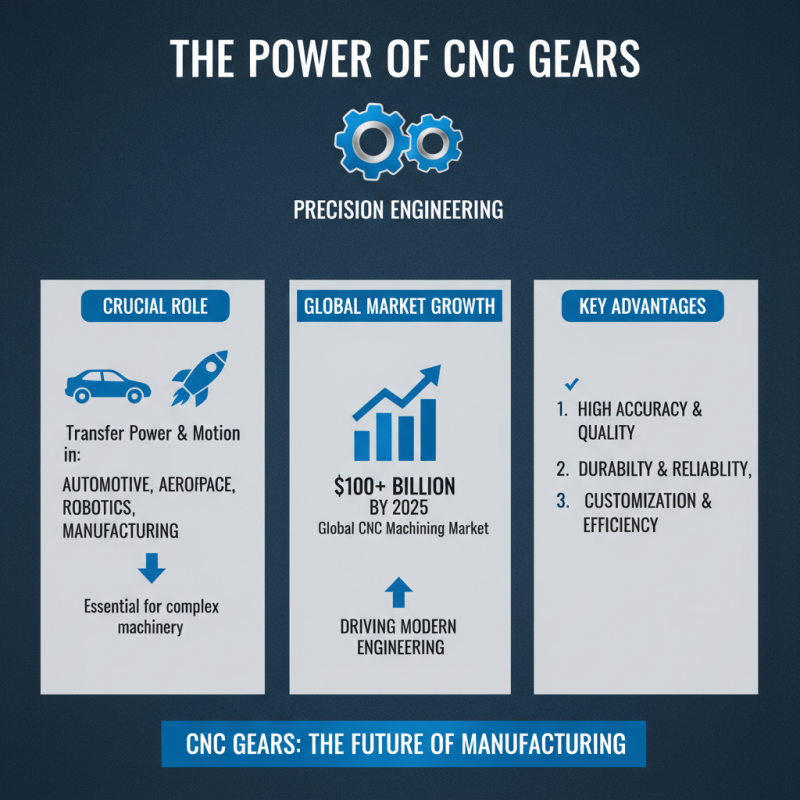
CNC gears play a crucial role in various industries, from automotive to aerospace. They are essential for transferring power and motion effectively. According to a recent industry report, the global CNC machining market is expected to reach over \$100 billion by 2025. This growth highlights the importance of CNC gears in modern engineering.
Understanding CNC gears involves looking at their types and applications. There are spur gears, bevel gears, and worm gears, among others. Each type serves specific needs. Spur gears are the most common and are known for their efficiency. In contrast, bevel gears are used when shafts intersect at an angle. Interestingly, a survey in 2022 found that over 25% of manufacturers encountered issues with gear precision during production. Such challenges can lead to costly delays and reduce overall efficiency.
Material choice is also vital. Common materials include steel, aluminum, and plastic. Each has advantages and drawbacks. For example, aluminum is lightweight but may not provide the strength needed for heavy-duty applications. A technical report noted that about 15% of gears fail due to material fatigue. This statistic emphasizes the importance of careful material selection and quality control. Engineers must consider these factors to ensure optimal performance in CNC gear design.
Key Characteristics of CNC Gears
CNC gears are vital in many industrial applications. Understanding their key characteristics can help in selecting the right type for your project. These gears are often made from durable materials like steel or aluminum. This ensures they can withstand high stress and wear over time. Precision fabrication enhances their performance. However, achieving perfect accuracy is always a challenge.
Another important feature is the gear tooth design. Different shapes can affect how gears mesh together. Common designs include spur, helical, and bevel gears. Each has its pros and cons. Some designs are more efficient, while others may introduce noise during operation. It’s crucial to weigh these factors based on the intended application.
Moreover, gear manufacturing processes can lead to variations in quality. Minor flaws can impact gear performance significantly. It’s vital to monitor these processes closely. Testing and inspection should not be overlooked. Ultimately, being aware of these characteristics can help you avoid costly mistakes in gear selection and enhance your project's overall efficiency.
Types of CNC Gears: An In-Depth Exploration
CNC gears come in various types, each designed for specific applications. Understanding these types is essential for engineers and designers. Some common types include spur, helical, bevel, and worm gears. Each one has unique characteristics and considerations.
Spur gears are the simplest and most widely used. They create a straight gear alignment, ideal for low-speed applications. However, they can be noisy and are suitable for lower torque applications. Regarding helical gears, their angled teeth enable smoother operation. They are quieter than spur gears but generate axial thrust, which must be managed properly.
Tip: When selecting gears, consider the application’s speed and torque requirements. Choosing the wrong gear can lead to inefficiency.
Bevel gears are designed for transmitting power between shafts at various angles. They are versatile but can require complex setups. Worm gears offer high reduction ratios but may have higher friction. This can impact efficiency negatively over time.
Tip: Regular maintenance can help mitigate the wear on gears. Monitoring performance can prevent costly downtimes.
Essentially, knowing these types can improve design choices. Avoid oversimplifying your gear selection. Reflect on the specific needs of your project carefully. Each type has its pros and cons; weighing these is key.
Top 10 Types of CNC Gears You Should Know About
| Gear Type |
Material |
Common Applications |
Advantages |
Disadvantages |
| Spur Gear |
Steel, Aluminum, Plastic |
Automotive, Industrial Machinery |
Simple design, High Efficiency |
Limited to parallel shafts |
| Helical Gear |
Steel, Bronze |
Automotive, Aerospace |
Smoother operation, Higher load capacity |
Complex manufacturing |
| Bevel Gear |
Steel, Cast Iron |
Right-angle drives, Spiral bevels |
Space-efficient design |
Lower efficiency than spur gears |
| Worm Gear |
Bronze, Steel |
Elevators, Conveyors |
High reduction ratios |
Low efficiency, Heat generation |
| Planetary Gear |
Aluminum, Steel |
Robotics, Electric Vehicles |
High torque density |
Complex assembly |
| Rack and Pinion |
Steel, Plastic |
Linear motion applications |
Good for linear movement |
Wear over time |
| Spiral Gear |
Steel, Cast Iron |
Industrial Machinery, automotive |
High strength, Smooth engagement |
Complicated design |
| Crown Gear |
Steel, Aluminum |
Differential drives, Machinery |
Suitable for angles |
Limited load capacity |
| Conical Gear |
Steel, Plastic |
Power transmission systems |
Compact structure |
Potential noise issues |
| Hypoid Gear |
Steel, Bronze |
Automotive differentials |
High efficiency, Smooth operation |
Complex machining process |
Applications of CNC Gears in Various Industries
CNC gears play a crucial role in various industries. They are designed to transmit motion and torque efficiently. These gears can be found in automotive applications, helping vehicles function smoothly. In aerospace, their precision ensures safety and reliability during flight.
Manufacturing also heavily relies on CNC gears. They are used in machinery that shapes materials. This improves production efficiency. In robotics, CNC gears enable precise movement, facilitating intricate tasks. The healthcare industry benefits as well, with gears in medical devices providing accurate operations.
Despite their advantages, there are challenges. Producing gears with high precision requires advanced techniques. Small errors can lead to significant issues later. Reflection on quality control is essential in this field. Each industry's needs vary, requiring constant adaptation. Understanding these nuances can lead to better designs and applications.
Choosing the Right CNC Gear for Your Project
Choosing the right CNC gear for your project can be challenging. Consider the specific requirements of your application. Different types of gears, like spur, bevel, and helical gears, serve unique purposes. For instance, spur gears are ideal for straightforward transmissions, while helical gears can handle higher loads.
Material selection is another crucial factor. Metals offer strength but may be heavier. Plastics can reduce weight but may not withstand high torque. Think about the environment, too. Will the gear be exposed to moisture or temperature extremes? Such details matter in your final choice.
Additionally, precision matters in CNC machining. A slight error can affect performance. Review your tolerances and ensure they align with your project’s needs. Not all CNC machines produce the same accuracy. Some may fall short. Be prepared to adjust your designs if necessary. Test different options and reflect on their performance. A good fit is often the product of trial and error.