Inquiry
Form loading...

What Are the Top CNC Bearing Manufacturers in China?

China’s bearing sector serves machine-tool builders, automotive suppliers, and industrial equipment makers. For buyers searching “Bearing Cnc,” choosing a manufacturer involves more than comparing prices. Runout, load capacity, heat treatment, lubrication, and delivery consistency all affect performance on the shop floor. Small differences matter. A spindle bearing that runs hot can disrupt an entire production shift.

Grand View Research’s Bearing Market Size, Share & Trends Analysis Report estimates the global bearing market at USD 118.9 billion in 2023, with growth projected through 2030. This figure describes the worldwide market, not China’s share or any individual factory’s quality. That distinction is easy to miss. This guide compares leading Chinese CNC bearing manufacturers through practical criteria: product range, precision claims, documented quality systems, customization, export experience, and technical support. Company specifications and certifications should be checked against current documentation, since product lines and approvals can change. Marketing language is not proof.

A list can help narrow the field, but it cannot replace application-specific checks. Buyers should confirm bearing dimensions, operating speed, preload options, traceability, and test records before placing orders. Manufacturer rankings also depend on what matters most: a high-speed spindle application may need different strengths from a machine-tool feed axis. The comparison ahead offers a grounded starting point, not a universal verdict.
What Are the Top CNC Bearing Manufacturers in China?

Understanding CNC Bearings and Their Role in CNC Machines

CNC bearings guide motion while controlling friction, runout, and heat. In a spindle, precision bearings support a rotating shaft under radial and axial loads. Their internal clearance and preload affect stiffness, vibration, and machining accuracy. Small parts. Big consequences. Linear guides and ball-screw supports also rely on bearings to keep tool movement smooth and repeatable. A slight increase in spindle temperature can change clearances and, in turn, influence finished dimensions.

Bearing choice depends on spindle speed, cutting forces, duty cycle, lubrication, and contamination control. Ceramic rolling elements may reduce mass and heat in some high-speed applications, but they are not automatically the best choice. Fit, preload, cooling, and installation quality matter just as much. Fortune Business Insights estimated the global bearing market at USD 126.4 billion in 2023; that broad figure includes many applications beyond CNC equipment. It shows the sector’s scale, not CNC-specific demand. One caveat: catalog accuracy figures alone do not predict performance inside a machine. Buyers should review operating conditions, maintenance access, and measured vibration or temperature data, then verify the bearing assembly after installation. I’d question any specification that promises precision without stating its test conditions.

What Are the Top CNC Bearing Manufacturers in China? - Understanding CNC Bearings and Their Role in CNC Machines

Bearing Type Typical CNC Machine Location Primary Role Key Selection Considerations Common Warning Signs
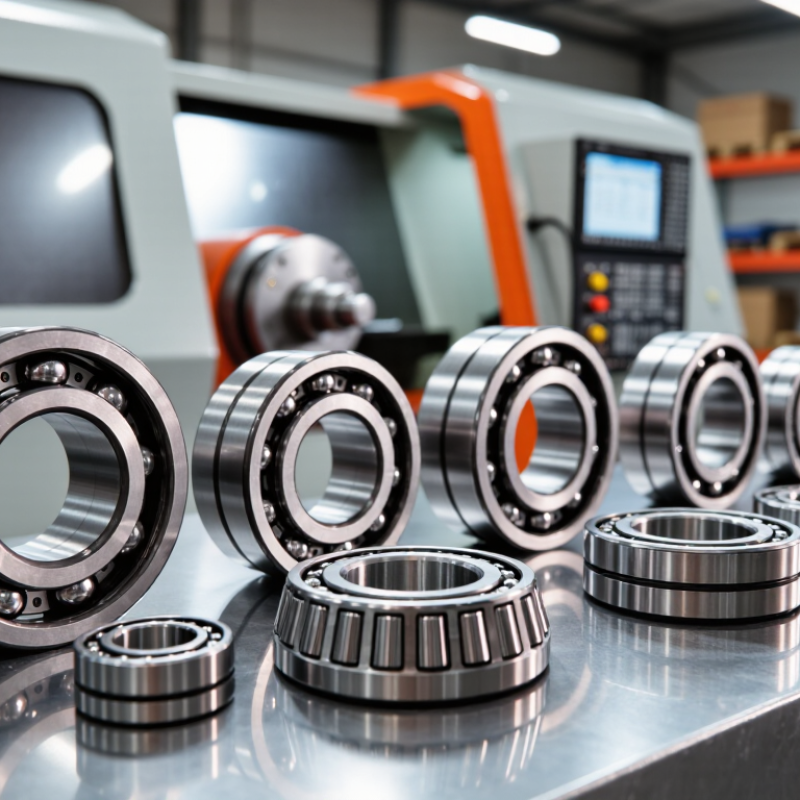
Precision angular-contact ball bearing Spindle assemblies and some rotary axes Supports combined radial and axial loads while enabling accurate, high-speed rotation. Contact angle, precision class, preload, arrangement, lubrication, and the spindle’s operating speed. Rising temperature, unusual noise, vibration, or reduced spindle accuracy.
Cylindrical roller bearing Machine-tool spindles and heavily loaded rotating assemblies Provides high radial load capacity and stiffness; some designs allow axial displacement within the bearing arrangement. Radial load, speed, internal clearance or preload, alignment, and the complete spindle arrangement. Abnormal vibration, heat, surface damage, or increased running noise.
Deep-groove ball bearing Motors, pumps, fans, and auxiliary machine components Supports mainly radial loads and moderate axial loads in compact, general-purpose applications. Load, speed, sealing, lubrication, contamination exposure, and mounting fit. Rough rotation, seal damage, lubricant leakage, or persistent noise.
Tapered roller bearing Gearboxes, drive assemblies, and selected rotary-axis systems Supports combined radial and axial loads; paired bearings can be adjusted to control end play or preload. Load direction, adjustment method, alignment, lubrication, and operating temperature. Excessive play, heat, uneven wear, or a change in operating noise.
Thrust bearing Vertical spindles, screw supports, and axial-load positions Designed primarily to carry axial loads; radial support may require a separate bearing. Axial load and direction, speed, stiffness requirements, lubrication, and mounting arrangement. Axial movement, overheating, noise, or visible raceway wear.
Crossed-roller bearing Rotary tables, indexing units, and precision positioning axes Supports radial, axial, and moment loads in a compact arrangement for controlled rotary motion. Moment load, rigidity, runout, mounting-surface accuracy, preload, and sealing. Increased rotational resistance, positioning error, noise, or loss of rigidity.

Bearing suitability and performance depend on the machine design, operating conditions, installation, and maintenance. Confirm dimensions, accuracy class, load ratings, speed limits, and lubrication requirements against the relevant technical documentation before selection.

How to Evaluate CNC Bearing Manufacturers in China

When evaluating CNC bearing manufacturers in China, look beyond catalog precision claims. Request dimensional inspection records, steel-mill certificates, heat-treatment charts, and batch traceability. Check that sample reports match the bearing’s actual drawing and tolerance class.

ISO 492:2023 defines dimensional and geometrical tolerance classes for rolling bearings; ask which class the supplier measures and how often. Details matter. A polished certificate alone cannot show whether inspection is consistent across production batches.

Ask for load-life calculations and test conditions, not just a promised service life. ISO 281:2007 calculates basic rating life at 90% reliability under stated operating assumptions. That figure is not a guarantee for every machine. Compare the assumptions with your speed, load, lubrication, and contamination risks.

For failure analysis, ISO 15243:2017 provides categories for rolling-bearing damage, helping teams distinguish issues such as wear and fatigue. A practical audit should also review runout, vibration, noise, and inspection equipment calibration. One weakness in a checklist: it can reward paperwork over repeatable results. Request recent batch data, then verify a small sample independently before approving a production order.

Leading CNC Bearing Manufacturers in China

China’s leading CNC bearing manufacturers serve demanding applications such as machine-tool spindles, ball screws, and linear motion systems. Their strengths vary: some focus on high-speed angular-contact bearings, while others produce larger or customized assemblies. Buyers should compare more than catalog dimensions. Ask about steel grades, heat treatment, preload options, lubrication, and stated runout tolerances. These details affect heat, vibration, and service life at operating speed.

Good suppliers can explain how products are inspected and provide relevant test records, drawings, and sample parts. A practical evaluation may include checking dimensions, running noise, and temperature under realistic conditions. Small details matter. A bearing that fits on paper may still perform poorly if its preload or lubrication does not match the spindle. Clear communication about lead times and customization is useful, too.

However, supplier descriptions alone are not proof of consistent quality. Request traceable documentation and discuss how defects are handled before placing a large order. I would not judge a manufacturer from one polished sample; repeatability across production batches can be harder to assess, and buyers should leave room for that uncertainty.

Comparing Manufacturers by Products, Quality, and Capabilities

What Are the Top CNC Bearing Manufacturers in China?
Comparing Manufacturers by Products, Quality, and Capabilities

China’s bearing sector is large, but output alone cannot show which supplier fits a CNC machine. The China Bearing Industry Association reported about 26.7 billion bearing sets produced in 2023. That scale creates broad options, from standard deep-groove bearings to precision spindle and angular-contact designs. A catalogue still tells only part of the story.

Compare product range against machine needs: spindle speed, load, operating temperature, and required runout. Ask for measured radial runout, vibration, and dimensional-tolerance records from actual production batches. ISO 281 provides methods for calculating bearing rating life; ISO 15243 classifies bearing damage and failure modes. These standards help frame technical questions, but they do not prove every product performs equally. Small details matter.

Manufacturing capabilities also separate suppliers. Look for controlled heat treatment, precision grinding, clean assembly areas, and traceable inspection records. Ask whether the supplier can provide batch-level measurement data and explain how it handles rejected parts. A documented quality system is useful, yet an audit and sample testing reveal more than a certificate alone. Be cautious with claims of “high precision” that lack tolerance figures. Real production has variation; a credible manufacturer should describe its limits plainly.

What Are the Top CNC Bearing Manufacturers in China? — Comparing Products, Quality, and Capabilities

ISO precision classes provide one neutral point of comparison when evaluating bearing quality. The index shown is ordinal only—not a tolerance measurement or a manufacturer score. When comparing manufacturers, also check their product range, published specifications, quality documentation, and application support. Actual class availability varies by product.

Choosing a Chinese CNC Bearing Manufacturer for Your Needs

Choosing a Chinese CNC bearing manufacturer starts with the demands of your application, not a catalog photo. Define the load, speed, operating temperature, and available installation space. Share a clear drawing and specify critical tolerances, materials, lubrication, and expected service life. Small details matter. A shaft fit that looks minor on paper can affect noise, heat, and wear in operation.

Ask how the manufacturer controls machining and inspection. Request sample measurement reports for dimensions such as bore size, radial runout, and surface finish. Check whether inspection equipment is calibrated and whether material or heat-treatment records can be traced to production batches. Ask about prototype quantities, minimum order sizes, and how rejected parts are handled. No process is perfect. Look for a supplier that explains limits openly instead of promising zero defects.

Communication deserves the same attention as technical capability. Send one practical question about a drawing revision or inspection requirement, then note how clearly the response addresses it. Confirm lead times, packaging, shipping terms, and the process for reporting quality issues before placing a large order. A factory visit or independent inspection may help when order value and risk justify the cost. Still, paperwork cannot replace a well-tested sample. Compare samples under realistic conditions, and keep your acceptance criteria in writing.