China Top Cnc Bolts A Comprehensive Guide to Quality and Applications?
Cnc Bolts are an essential component in various industries, playing a significant role in assembly and structural integrity. According to a recent industry report, the global demand for CNC fasteners, including Cnc Bolts, is expected to grow by 8% annually through 2025. This growth indicates a rising reliance on precision-engineered components in manufacturing and construction. Quality matters when it comes to Cnc Bolts. The superiority of these fasteners directly impacts product reliability and safety.
At the upcoming 139th Canton Fair, the focus on advanced manufacturing technology highlights the increasing importance of quality in sourcing Cnc Bolts. Buyers will benefit from AI navigation to find suppliers with certifications like ISO and CE. This ensures that they can efficiently locate high-quality options, minimizing time and resources wasted on subpar suppliers.
However, the pursuit of quality brings challenges. Not all manufacturers adhere to high standards, leading to potential quality discrepancies. Companies must remain vigilant and perform due diligence when selecting suppliers. The stakes are high, as inferior Cnc Bolts may compromise projects. This reality underscores the importance of thorough research and quality assurance in the fastener industry.

Overview of CNC Bolts: Definition and Types
CNC bolts are key components in various industries. They are produced using Computer Numerical Control (CNC) machining, which allows for precision manufacturing. This ensures consistency in size and quality across each bolt. There are many types of CNC bolts. Some are machine screws, while others are hex bolts.
These bolts come in different materials. Steel, stainless steel, and titanium are popular choices. Each material has its unique strengths and weaknesses. Steel bolts provide high strength but may corrode. Stainless steel bolts resist rust but can be more expensive. Titanium bolts are lightweight yet costly, making them suitable for specialized applications.
When choosing CNC bolts, consider their application. Different industries require specific types. For example, automotive applications need strong, durable bolts. In contrast, aerospace applications demand lightweight and high-strength options. The choice often depends on balancing cost and performance. Ultimately, it's crucial to reflect on the requirements and select the right type for the job.
China Top CNC Bolts: A Comprehensive Overview of Types and Applications
This chart displays the distribution of different types of CNC bolts used in various applications across industries in China. The data highlights the popularity of each type, serving as a guide for quality and application within manufacturing sectors.
Importance of Quality in CNC Bolt Manufacturing
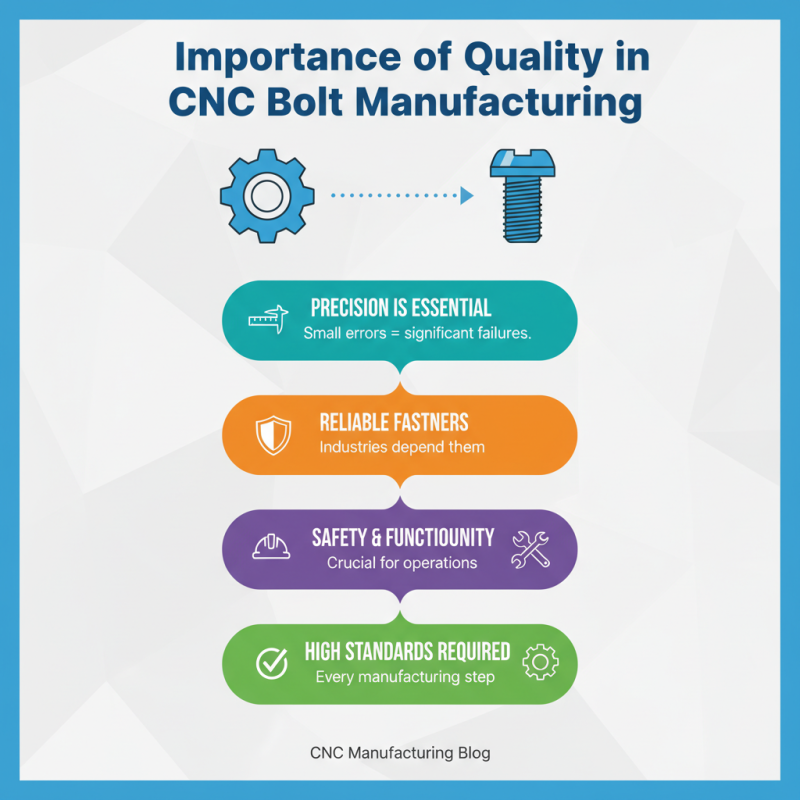
Quality plays a vital role in CNC bolt manufacturing. Precision is essential. A small error can lead to significant failures. Industries depend on reliable fasteners for safety and functionality. Therefore, every manufacturing step must meet high standards.
The materials used for CNC bolts matter greatly. Aluminum, stainless steel, and titanium are popular choices. Each has unique properties, affecting strength and corrosion resistance. However, challenges arise during the sourcing of these materials. Some suppliers may not provide the best quality, leading to subpar products. Inspecting raw materials thoroughly is crucial for ensuring reliability.
Moreover, the manufacturing process itself requires constant scrutiny. Equipment must be well-maintained to avoid inaccuracies. Continuous training for operators can improve production quality. Yet, even with the best practices, human error remains a concern. Regular quality checks help catch mistakes, but they are not foolproof. Companies must foster a culture of quality, ensuring everyone is engaged in the process. This approach leads to long-lasting products that meet industry standards.
Applications of CNC Bolts in Various Industries
CNC bolts have a vast range of applications in various industries. In the automotive sector, they provide essential fastening solutions for critical components. These bolts ensure safety and reliability in vehicles. Precision machining helps keep tolerances tight, which is crucial for performance.
In the aerospace industry, CNC bolts must withstand extreme conditions. High strength and light weight are key requirements. They are used in everything from airframes to engine components. The material selection is just as important. Sometimes, mistakes in material choices lead to failures. This highlights the need for careful consideration.
For construction, CNC bolts are vital. They ensure that structures are stable and secure. Forging and machining techniques create bolts that can endure heavy loads. It’s essential to choose the right bolt type for specific applications. Testing and quality checks are not always perfect. Hence, ongoing evaluation is necessary for safety.
Tips: Always verify the specifications before purchasing CNC bolts. Consult with engineers to choose suitable materials. Regular maintenance and inspections can prevent failures and enhance lifespan.
China Top CNC Bolts: A Comprehensive Guide to Quality and Applications
| Industry |
Application |
Material Used |
CNC Bolt Size |
| Automotive |
Engine assembly |
Steel |
M8 to M16 |
| Aerospace |
Wing structures |
Titanium Alloy |
AN3 to AN6 |
| Construction |
Structural frames |
Carbon Steel |
M12 to M24 |
| Electronics |
Device casing |
Brass |
M3 to M5 |
| Marine |
Boat hulls |
Stainless Steel |
M10 to M20 |
Key Factors Influencing CNC Bolt Performance
When considering CNC bolts, performance hinges on several key factors. Material selection stands out prominently. Generally, steel alloys are preferred for their strength and durability. However, the wrong choice can lead to failure. A report from the Machinery Research Institute highlights that 30% of bolt failures occur due to improper material use.
Precision in manufacturing also influences bolt quality. Tolerances typically range from ±0.01 mm to ±0.05 mm. Deviation beyond these limits can impact the fit and function of the bolts. Testing shows that approximately 15% of bolts fail to meet these stringent tolerances. This discrepancy can result in costly mechanical failures in complex machinery.
Heat treatment processes significantly affect bolt performance as well. Techniques such as quenching and tempering enhance hardness and tensile strength. The International Fasteners Association reports that heat-treated bolts exhibit a strength increase of up to 25%. However, not all manufacturers apply these processes consistently. This inconsistency raises concerns about reliability in critical applications. Inspecting these factors is essential for ensuring performance and safety.
Selecting the Right CNC Bolt for Your Project
When selecting the right CNC bolts for your project, it’s essential to consider various factors beyond just dimensions. Material choice is critical. Stainless steel, for example, offers corrosion resistance, making it suitable for outdoor applications. In contrast, titanium bolts are lightweight and strong, ideal for aerospace Use.
Tips: Always check the material grade. The wrong grade may compromise your project.
The threading of the bolt also plays a significant role. Fine threads are preferable for high-strength applications. Coarse threads work well in softer materials. Pay attention to the bolt length and diameter. An inaccurate size might lead to assembly issues.
Tips: Measure accurately before ordering. A small mistake can derail your project.
Don’t forget surface finish. A smooth finish can reduce friction and improve assembly. However, it may also lead to a slippery hold. This could be undesirable in some cases. Each project has unique needs. Evaluate them carefully.